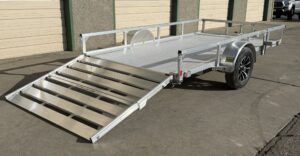

The short answer is a simple one: yes you do need to register and insure utility trailers in both Colorado and New Mexico. Luckily, we’re here to make it as simple as possible. Here we’ll break down exactly what’s expected of you and all the ways you can meet the various legal requirements that come with utility trailer ownership.
Understanding Trailer Registration Requirements
In both Colorado and New Mexico, all utility trailers must be registered in order to drive them on public roads. That said, the weight of the trailer can affect whether registration is permanent or annual and whether you’ll also need a title. There are even special procedures for homemade utility trailers, so it’s worth looking at the requirements in some detail.
Utility Trailer Registration Requirements in Colorado
Although all utility trailers must be registered in Colorado regardless of size, as of January 1st 2028 most will also be eligible for permanent registration. Owners will have to pay two years of ownership tax and statutory fees before their trailers can be permanently registered.
But whether you’re registering permanently or annually, you’ll need proof of ownership, ID, proof you’ve paid the relevant fees and taxes, and, if the trailer was previously titled in another state or is homemade, VIN verification. All of this should be done within 60 days of purchase at a Colorado DMV. The people at the DMV will help you with specific classification and determining the relevant taxes and fees you’ll owe.
Utility Trailer Registration Requirements in New Mexico
Like in Colorado, all utility trailers in New Mexico must be registered with the state MVD. Trailers not designed for commercial use under 6,001 lbs of Gross Vehicle Weight (GVW) can be registered permanently at a cost of $33 plus $7 for each 100 lbs over 500 lbs of GVW. For example, a 1,040 lbs trailer would cost $75 to permanently register. Trailers that are designed for commercial use or over that 6,001 lbs weight limit must be registered annually at a cost of $7 plus $1 for each 100 lbs over 500 lbs.
The documents required are the same for both registration types: proof of ownership, a weight certificate, proof of insurance for the towing vehicle, your own ID, and VIN inspection if your trailer does not already have a VIN.
How Trailer Weight Affects Registration in Other States
It’s important to note that while all utility trailer registrations are recognized in all states, a trailer that does not require registration in one state may do so in another. For example, many states exempt trailers under 2,000 lbs or so from registration. But if you buy such a trailer or even transport it into a state like Colorado or New Mexico that requires registration for such trailers, you risk fines if you fail to register it. These rules are generally stricter for commercial trailers.
Do You Need Insurance for a Utility Trailer?
In both Colorado and New Mexico, you can purchase standalone utility trailer insurance policies to extend the limited coverage provided by most personal auto insurance. For example, personal auto insurance generally doesn’t cover things like damage, fire, or theft to utility trailers. Likewise, anything being transported in the trailer is not covered.
When Your Auto Insurance Covers the Trailer
Most auto insurance policies in Colorado and New Mexico extend coverage to utility trailers, but only when they are hitched to the vehicle. Any physical damage, theft, etc. when the trailer isn’t hitched won’t be covered. Also, note that personal auto insurance does not cover commercial trailers, only commercial policies will. It’s always best to check the policies of your specific insurance and ask about utility trailer coverage when considering new plans for yourself.
When You Need a Standalone Trailer Policy
The big question you need to ask yourself to determine whether you need a standalone trailer insurance policy is whether you would need protection if your trailer is stolen, vandalized, or in an accident. If you’re a business, you almost certainly need a commercial policy. But for everyone else, consider what you transport, how often you use your trailer, and the value of the trailer itself before looking at available policies.
Commercial Use and Financed Trailers
As mentioned above, any utility trailers used commercially will need a commercial insurance policy to cover the trailer itself and the commercial goods being transported. Trailers that are being leased or still being financed will also generally need comprehensive coverage. These requirements will come from the leasing company of the lienholder, so be sure to ask about what kind of coverage they will need from you.
Does a Utility Trailer Need a Title?
Both Colorado and New Mexico require all utility trailers to be titled within 30 days of purchase. If you accidentally go over 30 days, you’ll need to pay late fees.
Utility Trailer Titling Requirements in Colorado
If you purchased a used trailer, you should get a signed title or notarized bill of sale from the previous owner. If that owner was out of state, you’ll need its out of state title or registration. If you purchased it from a dealer, you’ll need the dealer’s invoice. Then, just bring whichever of those documents you have along with ID, VIN verification, and a weight slip if the trailer is over 2,000 lbs to your local DMV. Once you pay the relevant fees and taxes, you’ll receive your title. Some states list the CWT or Curb Wight on the title. That would exempt you from needing a weight slip.
Utility Trailer Titling Requirements in New Mexico
The first document you’ll need in New Mexico is proof of ownership. If you bought it from a dealer, their invoice and a VIN inspection will be enough. If you bought it privately, a signed Certificate Bill or Title or Bill of Sale along with a VIN inspection and weight certificate if the title doesn’t include that information. Those documents along with ID and proof of liability insurance for the towing vehicle will be enough for the MVD to issue a title one the relevant fees have been paid.
Does a Utility Trailer Need a License Plate?
In Colorado, all utility trailers must have a license plate which you’ll receive when you register it with the DMV. In New Mexico, most trailers need a license plate but there are a few exceptions. Farmers or ranchers transporting items to and from their properties, individuals transporting animals to or from fairs, rodeos, or exhibits, or nonresidents using trailers to haul farm products from out of state producers do not need license plates. If you require one, you’ll get a plate when you register your trailer at the New Mexico MVD.
Utility Trailer Insurance and Registration FAQs
Can I register a trailer in Colorado or New Mexico without a title?
Both Colorado and New Mexico require utility trailers to be titled. Because the title is required to register your trailer so you’ll need to obtain it first.
What happens if I don’t register my trailer in New Mexico within 30 days?
If you are 1-30 days late registering your trailer in New Mexico you’ll incur a $10 late fee. After 31 days, the fee increases to 75% of your total registration costs.
Does my trailer need its own VIN?
Yes, utility trailers require a VIN. Standard trailers will have it stamped on a metal plate, while homemade trailers will need to go through a VIN assignment process.
Can I tow a trailer with paper plates?
As long as your temporary paper tags are valid, properly displayed, and you carry the Bill of Sale and temporary registration documents with you, you can tow your trailer.
Does trailer insurance cover the contents inside the trailer?
Standalone trailer insurance generally does not cover the contents of the trailer itself. These may be covered by homeowners, renters, or dedicated cargo coverage. It’s best to check your policy or speak to a specialist to be sure.
Is trailer insurance required to get a license plate in Colorado or New Mexico?
Neither Colorado nor New Mexico require standalone trailer insurance in order to get a license plate. Such insurance is generally only required for commercial use trailers.
What to Do After Buying a Utility Trailer from Pine Country
With so many complex requirements in both Colorado and New Mexico, it just makes sense to buy your utility trailer from people with deep practical experience and expertise. Whether you’re looking at buying a new or used trailer or just want some help understanding what’s practical to meet your needs, we’re here to help.
Our specialists can walk you through everything you need to know about purchasing, registering, titling, insurance, using, and maintaining a utility trailer in Colorado or New Mexico. So don’t hesitate to get in touch with us if there’s anything at all we can help you with.